Introduction
The MQ Controller provides communication and control between the field devices and the other nodes on the control network. Control strategies and system configurations created on earlier DeltaV™ systems can be used with this powerful controller. The MQ Controller provides all the features and functions of the MD Plus Controller, with the same amount of memory.
The control languages executed in the controllers are described in the Configuration Software Suite product data sheet.
Benefits
Increases productivity
The MQ Controller is as quick as the MD Plus Controller and provides the same configurable memory as the MD Plus controller. The Ethernet ports are full duplex, 100MB/second maximum throughput. The results are lower CPU utilization and higher capacity for control strategies.
Self-addressing. The DeltaV controller is unique in its ability to automatically identify itself to the DeltaV control network.
When the controller is powered up, it is automatically assigned a unique address—no dip switches, no configuring—just plug and play!
Self-locating. A controller’s physical location is easy to find. LEDs on the face of the controller can be made to flash, providing a strong visual clue.
Automatic I/O detection. The controller can identify all I/O interface channels located on the subsystem. As soon as an I/O interface is plugged in, the controller knows the general characteristics of the field devices managed by that I/O interface. This reduces the no value engineering associated with configuration — easy!
Connect to Electronic Marshalling and Wireless I/O.
Starting in DeltaV v14.3, CHARMs and wireless devices connected through CHARM I/O Cards (CIOC) and Wireless I/O Cards (WIOC) can be assigned to the MQ controller.
This makes it easier than ever to add I/O to an existing controller by simply adding a CIOC and/or WIOC to the DeltaV Area Control Network.
Easy to use
Total control. The controller manages all control activities for the I/O interface channels. It also manages all communication functions for the communications network. Time stamping, alarming, and trend objects are also managed within the controller. The controller executes all control strategy with execution speeds up to every 100 ms.
Data protection. All online changes made to control parameters are automatically stored for later upload into the engineering database. This way, the system always retains a complete record of all the data that has been changed online.
Cold restart. This feature provides automatic restart of the controller in case of a power failure. The restart is completely autonomous because the entire control strategy is stored in NVM RAM of the controller for this purpose. Simply set the restart state of the controller to current conditions.
Has the flexibility to meet your needs
Advanced operations. The MQ Controller is equipped to handle the DeltaV Batch option, as well as advanced control functions.
You can also use advanced control function such as Neural and Model Predictive Control on the MQ controller.
Data pass-through. The controller is equipped with the ability to pass smart HART® information from field devices to any workstation node in the control network. This means you can take advantage of applications, such as Asset Management Solutions AMS Device Manager, that enable you to remotely manage the HART information contained in your HART or FOUNDATION Fieldbus equipped devices.
Prepares you for the future. As your system grows, you can expand your software license to increase the number of device signal tags (DSTs) allocated to the DeltaV controller. Begin with 50 and expand to 750 DSTs. Control strategy complexity and control module scan rates determine overall controller performance and application size. A redundant
controller may be added to back up an MQ Controller online. The standby controller comes online automatically, with a bumpless transition. For more information, refer to the I/O Redundancy product data sheet.
Mounting. This plug-and-play system structure provides modular system growth with a single controller and can be mounted in a Class 1, Div 2 or ATEX Zone 2 environment. Refer to the System Power Supplies and I/O Subsystem Carriers product data sheets for additional information.
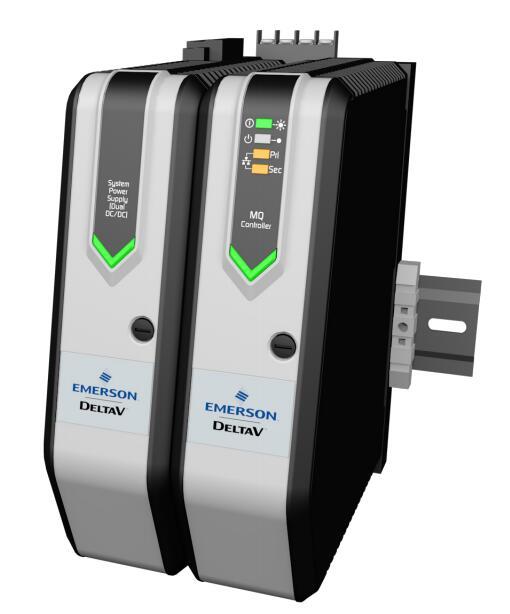
The MQ Controller.
Designed to support legacy migration
Advanced operations. The MQ controller provides the DeltaV platform to migrate PROVOX and RS3 controllers, and also supports the PROVOX and RS3 Migration I/O interfaces.
The existing PROVOX I/O remains in place using the migration I/O interface to PROVOX with support of up to 750 real I/O signals. Serial datasets are migrated to DeltaV serial cards and all virtual I/O are no longer required due to the direct module references possible in the DeltaV system.
RS3 system migrations to the DeltaV system are fully supported with MQ Controllers and the migration I/O interface for RS3.
DeltaV MQ controller hardware dimensions.
Specifications
|
Power, Mounting, and Memory
|
|
Power Requirement
|
Supplied by System Power Supply through 2-wide Power/
Controller Carrier
|
|
Fuse Protection
|
3.0 A, non-replaceable fuses
|
|
Power Dissipation
|
5.0 W typical, 7.0 W maximum
|
|
Mounting
|
On right slot of power/controller carrier
|
|
User Memory
|
48 MB
|
|
Primary Control Network
|
8-pin RJ-45 connector
|
|
Redundant Control Network
|
8-pin RJ-45 connector
|
|
LED Indicators (ON Status)
|
|
Green – Power
|
Indicates DC power is applied
|
|
Red – Error
|
Indicates an error condition
|
|
Green – Active
|
Indicates that the controller is operating as the primary controller
|
|
Green – Standby
|
Indicates that the controller is operating as a backup controller
(reserved for future use)
|
|
Yellow Flashing – Pri. CN
|
Indicates valid primary control network communication
|
|
Yellow Flashing – Sec. CN
|
Indicates valid secondary control network communication
|
|
All except Power flashing
|
Visual identification of controller initiated from user interface
software by ping command
|
|
All except Power flashing, alternating even and odd
|
Firmware upgrade in progress
|
|
Environmental
|
|
Operating Temperature*
|
-40° to 70°C (-40° to 158°F)
|
|
Storage Temperature
|
-40° to 85°C (-40° to 185°F)
|
|
Relative Humidity
|
5 to 95%, non-condensing
|
|
Airborne Contaminants
|
ISA-S71.04-1985 Airborne Contaminants Class G3
Conformal coating
|
|
Shock (normal operating conditions)
|
10 g ½-sine wave for 11 ms
|
|
Vibration (operative limit)
|
1 mm peak-to-peak from 5 Hz to 16 Hz,
0.5 g from 16 Hz to 150 Hz
|
*Operating any electronics at the higher end of its temperature range for long periods of time will shorten its expected lifetime, see Effects of Heat and Airflow Inside an Enclosure White Paper for more information.
Certifications
The following certifications are available on the MQ controller (see actual certificates for exact certifications).
• CE
EMC- EN 61326-1
• FM
FM 3600
FM 3611
• CSA
CSA C22.2 No. 213
CSA C22.2 No. 61010-1
• ATEX
EN 60079-0
EN 60079-7
• IEC Ex IEC60079-0 IEC60079-7
• Marine Certifications: IACS E10
ABS Certificate of Design Assessment DNV Type Approval Certificate
• Wurldtech
Achilles Communications Certification Level 2
Hazardous Area/Location
The MQ Controller can be installed and used based on the following Standards (see actual certificates for exact product markings):
• FM (USA)
Installation:
Class I, Division 2, Groups A, B, C, D, T4
• cFM (Canada)
Installation:
Class I, Division 2, Groups A, B, C, D, T4
• ATEX
II 3G Ex ec IIC T4 Gc
• IEC Ex
Installation:
II 3G Ex ec IIC T4 Gc
Regarding the Installation instructions please refer to the following Documents: Class 1 Division 2 Installation Instructions DeltaV M-series (12P1293)
Zone 2 Installation Instructions DeltaV M-series (12P2046)